Data informed allows the manager to keep collecting data until the desired answer can be justified.
This conversation summarizes a project worked on decades ago. It was a project evaluating multiple competitors for a major bid we'd released to tender. It was valued in the high 8 figures, so competition was intense. We started with something like 70 bidders, quickly narrowed it down to 8 qualified ones, and then started doing deeper dives into the bids to narrow it down.
This wasn't easy, as the bidders all had different feature sets, and whatever we went with would be used by multiple divisions of our multinational company. My team was responsible for developing the comparison criteria, and then doing the comparison. This took almost a year. It was complex.
One bidder was consistently ranked higher than the others. Unfortunately, it was a bidder that a lot of people disliked (think Microsoft today). But the data was clear. My boss, it turned out, had a personal gripe with a major exec at the bidder, who stood to get a massive bonus if we picked them. So, he kept us looking for new criteria that would disqualify them, but never could.
Finally, our own execs got involved, wanting to know why it was taking us so long to make a recommendation. When they looked at the numbers, and saw that the vendor was clearly the winner (about 85% positive to 40% positive for the second highest), they demanded to know why we hadn't recommended them.
Our boss gave a wonderful speech that said lots of nothing, but it boiled down to the fact that the "data driven" answer would choose the disliked vendor, so we were being more "data informed", instead.
Our execs weren't, and picked the data driven answer the next day. This put my boss in the amusing situation of having write a report to justify a decision that had already been made, but that he disagreed with.

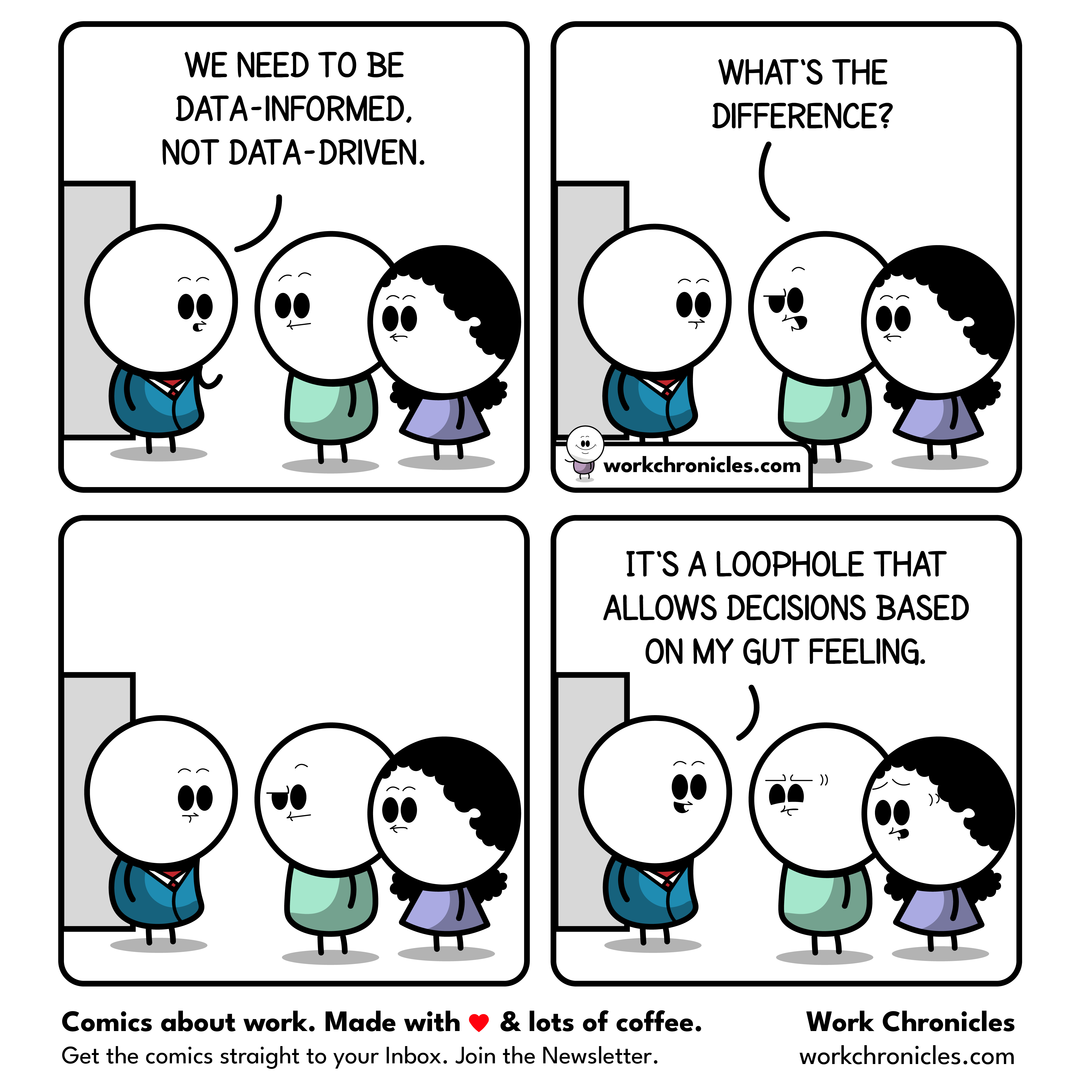
Data informed allows the manager to keep collecting data until the desired answer can be justified.
This conversation summarizes a project worked on decades ago. It was a project evaluating multiple competitors for a major bid we'd released to tender. It was valued in the high 8 figures, so competition was intense. We started with something like 70 bidders, quickly narrowed it down to 8 qualified ones, and then started doing deeper dives into the bids to narrow it down.
This wasn't easy, as the bidders all had different feature sets, and whatever we went with would be used by multiple divisions of our multinational company. My team was responsible for developing the comparison criteria, and then doing the comparison. This took almost a year. It was complex.
One bidder was consistently ranked higher than the others. Unfortunately, it was a bidder that a lot of people disliked (think Microsoft today). But the data was clear. My boss, it turned out, had a personal gripe with a major exec at the bidder, who stood to get a massive bonus if we picked them. So, he kept us looking for new criteria that would disqualify them, but never could.
Finally, our own execs got involved, wanting to know why it was taking us so long to make a recommendation. When they looked at the numbers, and saw that the vendor was clearly the winner (about 85% positive to 40% positive for the second highest), they demanded to know why we hadn't recommended them.
Our boss gave a wonderful speech that said lots of nothing, but it boiled down to the fact that the "data driven" answer would choose the disliked vendor, so we were being more "data informed", instead.
Our execs weren't, and picked the data driven answer the next day. This put my boss in the amusing situation of having write a report to justify a decision that had already been made, but that he disagreed with.
Well, if we make data driven decisions they'll blame me, otherwise I get to blame you guys 🤭